South Africa's electricity supply has improved significantly over the past year. For most commercial farming operations, load-shedding has receded as an acute operational concern. That is genuinely good news.
But the energy cost picture for farming has not improved. It has got worse. Eskom's approved tariff increases have pushed grid electricity costs substantially higher, and diesel — the fuel that powers most commercial farm equipment in South Africa — is now subject to a new set of pressures that have nothing to do with Eskom and everything to do with what is happening in the Middle East.
The argument for solar-powered agricultural robots in South Africa never depended entirely on load-shedding. Load-shedding made it urgent. The underlying argument — energy independence as a hedge against costs you cannot control — is now more relevant, not less.
What has happened to diesel prices
The conflict involving Iran and its effects on oil transit through the Strait of Hormuz have contributed to a significant increase in crude oil prices in early 2026. The Strait of Hormuz handles roughly 20% of global oil trade. When that chokepoint is at risk, crude prices respond, and that response flows through to the pump price for diesel in South Africa within weeks.
At the time of writing, commercial diesel in South Africa is above R25/litre. That price reflects the combination of the crude oil price spike, the Basic Fuel Price mechanism that translates international crude into domestic pump prices, and the rand/dollar exchange rate — which introduces a second layer of exposure to global financial conditions.
South African farmers have no hedge against this. They need diesel to run tractors, pumps, generators, and transport. A 300ha dryland operation in the Free State might consume 25,000 to 35,000 litres of diesel per season across tillage, planting, and harvest support. At R25/litre, that is R625,000 to R875,000 in fuel — and that number can move by 15 to 20% within a single season if crude prices shift.
This is not a new problem. It is a permanent structural feature of farming in a commodity-price-exposed country with a volatile currency. The question for 2026 is whether new technology makes it a problem that can be partially solved.
What solar-autonomous farm robots actually change
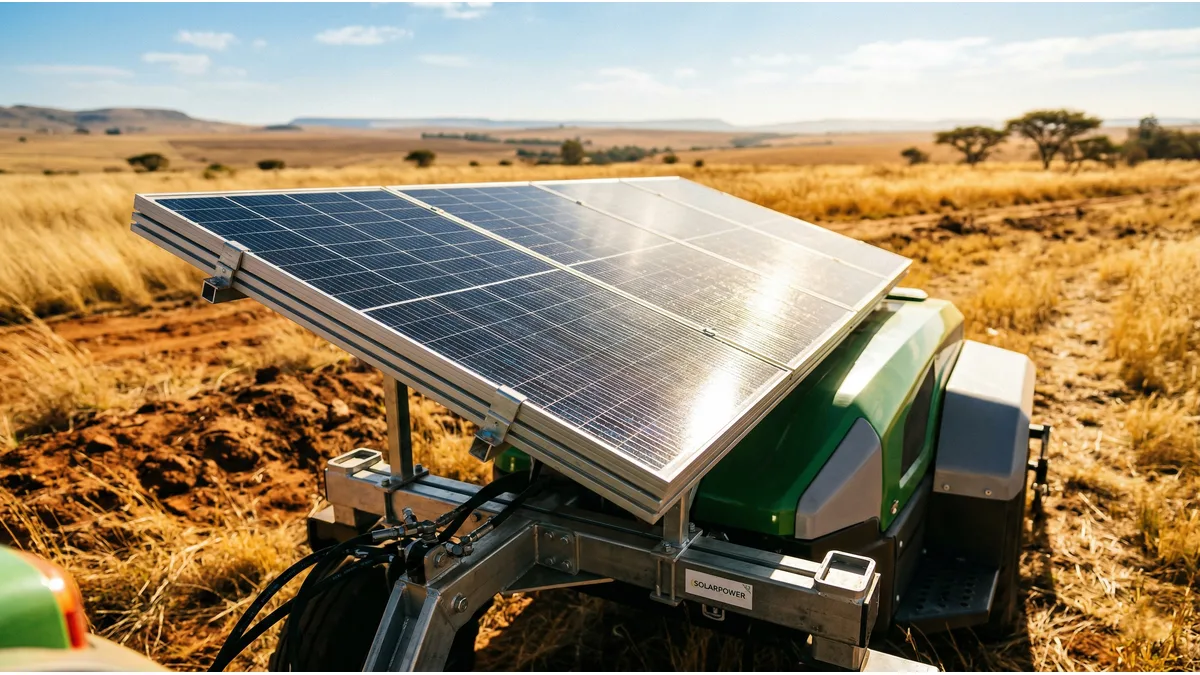
The FarmDroid FD20 is a Danish-built agricultural robot designed for row crops — maize, vegetables, wheat, brassicas. It seeds and weeds in a single pass, using RTK-GPS precision to place seeds and then return to the exact planting positions to remove weeds mechanically without damaging the crop.
It runs entirely on solar power through integrated panels and an onboard battery. It does not use diesel. It does not draw from the grid. Its operating energy cost, once purchased, is effectively zero.
For a European farmer with stable, moderately-priced electricity and diesel, this is a cost advantage worth calculating. For a South African farmer facing diesel at R25+/litre with upward price risk, and grid electricity that has roughly doubled in real terms over the past decade, it is a structural shift in operating economics.
The relevant comparison is not just diesel versus solar. It is also about the driver cost. A conventional tractor running a mechanical weeder requires a driver. The FD20 operates unattended once configured — a farm manager sets the job parameters, and the robot works through the day and into the night. The labour saving is a second line item in the cost calculation, relevant in its own right given the Western Cape and Gauteng labour availability issues discussed in other articles on this site.
The broader pattern: energy independence as a farm strategy
The FarmDroid is one example of a wider pattern in agricultural robotics design. Halter's virtual fencing system for dairy and beef cattle runs on solar-charged animal collars and on-farm solar towers — no grid connection required for the farm network. Monarch Tractor's MK-V is an electric tractor that charges from solar or grid power, displacing diesel on the tasks where a conventional tractor would run on fossil fuel throughout the day.
In each case, the energy architecture was designed around solar independence for reliability reasons — because the products need to work in remote pastoral environments or large-scale farms where grid connection is impractical. The effect is that these products enter the South African market with an energy cost profile that is substantially insulated from the fuel price volatility that exposes conventional equipment.
This is worth sitting with for a moment. These are not "green farming" products sold on an environmental premise. They are commercial products built around an energy independence model that happens to align very well with the cost pressures facing South African commercial farmers in 2026.
The honest limits of the argument
Solar-dependent farm robots are, obviously, dependent on solar radiation. South Africa's solar irradiance is among the highest in the world — the Free State, Northern Cape, and most of the Western Cape are excellent solar environments. The Eastern Cape coastal belt and parts of KZN that see significant cloud cover and fog are somewhat less favourable, and this is worth assessing in any deployment evaluation.
These products also carry a capital cost that must be weighed against the operating cost savings. The FarmDroid FD20 is priced for European farm economics and translates at current exchange rates to a meaningful rand investment. The payback model needs to be built for each specific farm — using actual diesel consumption, actual labour cost, actual crop and scale — not assumed from European case studies.
AgriBots is working through exactly this analysis for the South African market, and it will be published on this site as it becomes available.
The timing question
One of the more common questions from farmers looking at autonomous equipment is whether to wait — for prices to come down, for the technology to mature further, for a local distributor to be fully established.
The honest answer is that the technology is commercially mature now. FarmDroid has several hundred units in operation across Europe. Halter has 600,000+ cattle on-collar across New Zealand, Australia, and the United States. These are not experimental products.
What is not mature in South Africa is the distribution, service, and support infrastructure. That is what AgriBots is building. The farmers who engage with this process now — who share their farm profile, ask questions, and help us understand where demand is concentrated — shape the order in which that infrastructure gets built.
If energy cost reduction is a meaningful part of your farming operation's financial picture, this is a conversation worth having.
Relevant to your farm?
If energy cost reduction matters to your operation, tell us about your farm. The farmers who engage now shape which technologies arrive first.
Tell us about your farm